
13-12-2010
If you cannot see this email correctly click Here
Gravity-Defying Homes
The expression "living on the edge" is about to take on a whole new meaning. Homes dangling from trees, balancing on sticks, hanging upside down, rotating around a spit, for architecture that redefines the laws of gravity.
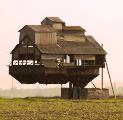
Floating Castle (Ukraine)
Supported by a single cantilever, this mysterious levitating farm house belongs in a sci-fi flick. It’s claimed to be an old bunker for the overload of mineral fertilizers.
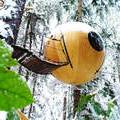
Free Spirit Houses (British Columbia, Canada)
These wooden spheres can be hung from any solid surface (tree, cliff, bridge, etc.) and are accessed by a spiral stairway or a short suspension bridge. A web of rope grasps onto a strong point, essentially replacing the foundation of a conventional building. You can anchor points on the top and bottom to prevent swinging or just let it loose and enjoy the ride.
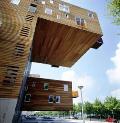
Wozoco Apartments (Amsterdam-Osdorp, Holland)
A zoning law were the inspiration for this apartment complex. Dutch housing regulations require apartment construction to provide a certain amount of daylight to their tenants–but MVRDV architects forgot to plan for that. Their solution? To hang thirteen of the 100 units off the north facade of the block. The ingenious design saves ground floor space and allows enough sunlight to enter the east or west facade.
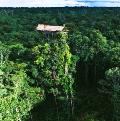
Extreme Tree House (Irian Jana, Indonesia)
The Korowai and Kombai clans carved out clearings of the remote part of the low-land forest to make way for these extreme tree houses. Unlike the typical tree houses that are nestled in branches, these dwellings are perched on the tip tops of the trees fully exposed to the elements.
Architectural Terms
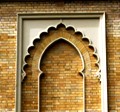
Blind Arch
An arch that has been filled in by brick or stone. This could be original decoration or part of a renovation.
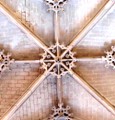
Boss
From the Gothic era, an ornament placed at the intersection of ribs in a ceiling whether vaulted or flat.
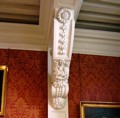
Bracket
An ornamental projection from the face of a wall providing visual or structural support for a statue, cornice, balcony, or window.
Famous Architects
Arata Isozaki (1931 – Present)
Arata Isozaki is known for using bold, exaggerated forms and inventive detailing. He often integrates Eastern ideas into his designs. Many critics have identified Arata Isozaki with the imaginative, Japanese New Wave movement known as Metabolism.
Read MoreArchitectural Styles
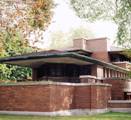
Prairie Style (1893s – 1920s)
Frank Lloyd Wright believed that rooms in Victorian era homes were boxed-in and confining. He began to design houses with low horizontal lines and open interior spaces. These homes were called prairie style after Wright’s 1901 Ladies Home Journal plan titled, “A Home in a Prairie Town.”
Read More
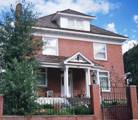
American Foursquare (1895 – 1930s)
The American Foursquare, or the Prairie Box, was a post-Victorian style that shared many features with the Prairie architecture pioneered by Frank Lloyd Wright. The boxy foursquare shape provided roomy interiors for homes on small city lots.
Read More
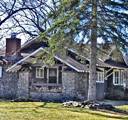
Arts and Crafts (1905 – 1930s)
The name “Craftsman” comes from the title of a popular magazine published by the famous furniture designer, Gustav Stickley, between 1901 and 1916. A true Craftsman house is one that is built according to plans published in Stickley’s magazine. But other magazines, pattern books, and mail order house catalogs began to publish plans for houses with Craftsman-like details. Soon the word “Craftsman” came to mean any house that expressed Arts and Crafts ideals, most especially the simple, economical, and extremely popular Bungalow.
Read MoreOrtner Design Newsletter - Issue 9 - December 13, 2010
If you no longer wish to receive this newsletter please click Here to unsubscribe. For any other questions please send an email to Ortner design


Posted on: Beverly Hills Real Estate-Beverly Hills Homes For Sale


No comments:
Post a Comment